By Sudhiksha Varanasi
Summary
Deep-sea life thrives under crushing pressure, freezing temperatures, and complete darkness. Through remarkable evolutionary adaptations, these organisms survive where few others can. Studied using advanced ocean technology, they offer powerful insights for science and biomimicry.
Introduction:
Life in the deep ocean thrives in the absence of sunlight, high pressures and low temperatures. Unlike surface-level sea animals which have abundant resources to easily survive on, deep-sea species exhibit unique physiological adaptations to survive and even flourish under extreme and bizarre conditions. Their abnormal appearances are due to the effects of prolonged evolution shaped by environmental factors. Data for this study was collected by employing a combination of advanced technologies, which includes Remotely Operated Vehicles (ROVs) and submersibles to explore the ocean floor. These ROVs are often equipped with specialized devices that mimic natural signals to attract the marine animals inhabiting the deep ocean. With these findings and collected data, our understanding of sea creatures is enhanced and can be used in biomimicry for developing better survival mechanisms and other biotechnological advancements.
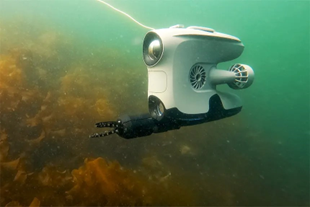 Fig: Remotely Operated Vehicle (ROV) with Manipulator Arm:
An underwater ROV equipped with a mechanical grabber, used for tasks such as sampling, inspection, and object retrieval in marine environments.
Fig: Remotely Operated Vehicle (ROV) with Manipulator Arm:
An underwater ROV equipped with a mechanical grabber, used for tasks such as sampling, inspection, and object retrieval in marine environments.
Keywords:
Bioluminescence, adaptation ecosystems, protein folding, chemosynthesis, hydrothermal vents.
The deep sea, around a depth of 200m (approx. 656 feet) from the surface, is defined as the depth at which light starts to dwindle. This region marks the transition from the sunlit epipelagic zone to the darker, colder regions below and beyond. While these conditions are considered “extreme” and “bizarre” to humans, the deep sea is the largest habitat on Earth, making this the “norm” for the species inhabiting the ocean. As we go deeper into the ocean, the density of animals decreases [3]. So how do the species survive? Here are a few adaptations and processes they use.
I. Enduring Extreme Pressure:
Barophiles use chemical and structural strategies to make sure the extreme pressure, which is a hundred times greater than at the surface, has little to no effect on their cells and proteins. Their proteins contain a unique amino acid composition, ensuring proper protein folding (the conversion of a protein from an unstable coil to a more ordered three-dimensional structure) and function under pressure. Mainly, their cells possess a molecule TMAO (trimethylamine N-oxide), which proves the most effective against high pressure.
It is seen that the amount of TMAO increases in animals with the depth of their habitat. Many deep-sea fish have gelatinous bodies and minimal skeletal mass. Their bodies are mostly made of water, minimizing the internal and external pressures experienced.
 Fig: Molecular Structure of TMAO:
The chemical structure of trimethylamine N-oxide (TMAO), showing its central nitrogen atom bonded to three methyl groups and an oxygen atom, forming a stabilizing osmolyte used by deep-sea organisms.
Fig: Molecular Structure of TMAO:
The chemical structure of trimethylamine N-oxide (TMAO), showing its central nitrogen atom bonded to three methyl groups and an oxygen atom, forming a stabilizing osmolyte used by deep-sea organisms.
II. Metabolic adaptations:
Chemosynthesis is a process of using chemical energy to synthesize food instead of sunlight. This is generally observed near hydrothermal vents and cold seeps. Bacteria oxidizes compounds such as hydrogen sulphide and methane to produce food, forming the base of the food web to larger organisms. To use this energy to the fullest, the majority of deep-sea fish have extremely slow metabolism, limiting their energy usage to only basic and necessary functions. This allows them to subsist on the scarce food found to them. Animals such as tube worms, mussels and clams house these chemosynthesizing bacteria to produce food for them. They provide the bacteria with oxygen and chemicals in exchange for organic nutrients.
III. Survival in Total Darkness:
Light emitted by living beings through chemical processes is known as bioluminescence. There are namely 3 main uses of bioluminescence:
i. Luring prey. e.g. the angler fish which has a tube-like structure attached to its head emitting light helping it to easily capture clueless prey.
ii. Attracting to mate.
iii. Camouflage.
Animals which use bioluminescence have extremely light-sensitive vision, enabling them to catch the smallest flicker of light. They have enlarged eyes to aid their vision. Contrary to this, some creatures lose their eyes completely as they are not useful. This can be seen in the case of the Faceless Cusk Eel whose eyes are either sunken or non-functional.
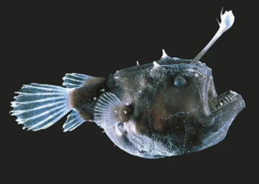
Fig: Anglerfish (Close-Up): A view of an anglerfish, showing its bioluminescent lure and specialized adaptations for capturing prey in low-light environments.
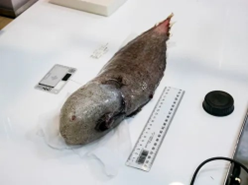 Fig: Faceless Cusk Eel: A collected specimen of the faceless cusk eel, characterized by its reduced facial features and elongated body, adapted for life in the ocean
IV. Cold Water Adaptations:
Most of the deep ocean has a temperature slightly above freezing (2℃ - 4℃). Some fish possess antifreeze glycoproteins in their blood and bodily fluids. These proteins circulate around the body and stick to the ice crystals, stopping their growth and preventing the fish from becoming solid. Icefish, mostly found in Antarctica, possess these proteins. The icefish is also the only known vertebrate to lack haemoglobin. It depends on the higher solubility of oxygen in extremely cold water which is absorbed into its transparent blood. With a larger heart, it circulates the blood to conserve energy.
There are a lot more mysteries hidden in the deep ocean but expeditions to explore are both expensive and difficult. Traditional robots are rigid and cannot handle extreme pressure. They require heavy, expensive, metallic pressure vessels to protect the inner components of the robots. Plus, the maintenance of underwater vessels is time-consuming and difficult. Seeing how the deep-ocean species easily live down there, undoubtedly there is a way to explore the ocean with the same ease.
So, what are the characteristics adapted by these robots?
-
Robots used in expeditions use up a lot of power and are very noisy. To counter this, scientists have developed bionic robots that mimic the movements and structure of a jellyfish. The “Underwater Phantom” is a jellyfish-inspired bionic robot developed by Chinese researchers. This robot is nearly invisible to the naked eye, made up of materials like hydrogel, ensuring less noise. It is capable of underwater exploration and real-time monitoring. The main features of this “jellyfish” is its low noise, ultra-low power consumption, and high-level biomimicry, helping it to easily blend in. This innovation proved successful with its efficient maneuverability. [4]
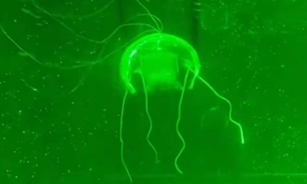 Fig: Biomimetic Jellyfish-Like Underwater Robot:
A jellyfish-inspired underwater robotic prototype exhibiting soft, bell-shaped propulsion, designed for efficient, low-disturbance movement in aquatic environments.
Source: Northwestern Polytechnical University.
Fig: Biomimetic Jellyfish-Like Underwater Robot:
A jellyfish-inspired underwater robotic prototype exhibiting soft, bell-shaped propulsion, designed for efficient, low-disturbance movement in aquatic environments.
Source: Northwestern Polytechnical University. -
As mentioned earlier, traditional robots have rigid arms which makes it difficult to collect and inspect objects in small corners and nooks. To counter this problem, robots inspired by the octopus were introduced. These robots had soft arms with suction cups, just like the octopus. Octopi are extremely flexible, making them capable of squeezing themselves into tight spaces and their soft arms easily grab objects.
Design: Robots mimic the conical and muscular shape of an octopus arm, made from soft materials such as silicon elastomers.
Function: They can easily bend and twist in different directions with integrated suction cups, allowing them to easily pick up delicate items such as eggs. [5]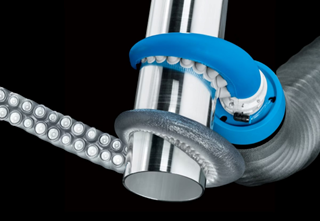 Fig: Octopus-Inspired Soft Robotic Arm:
A soft robotic manipulator developed at Harvard that uses flexible, suction-enabled tentacle-like segments to grasp a metal cylinder. The design demonstrates adaptive, high-compliance gripping inspired by octopus arm mechanics.
Source: Wyss Institute, Harvard University.
Fig: Octopus-Inspired Soft Robotic Arm:
A soft robotic manipulator developed at Harvard that uses flexible, suction-enabled tentacle-like segments to grasp a metal cylinder. The design demonstrates adaptive, high-compliance gripping inspired by octopus arm mechanics.
Source: Wyss Institute, Harvard University. -
Electronic components in robots break under extreme pressure, and propellers consume a lot of power. To maintain these components and provide power to the propellers is costly and time-taking. Scientists developed the “Snailfish Robot” to counter this. The Mariana Snailfish, one of the deepest-living fish, is a soft-bodied tadpole-like fish with unpigmented skin, reduced bone tissues, and enlarged organs to survive the impact of extreme pressure. Similarly, this robot uses a soft body and loosely distributes its rigid components that are separated by soft padding. It imitates how the snailfish’s skull is not fully fused, evenly spreading the pressure across its body without any damage.
Limitations:
Even with so many advancements and findings, there are still challenges faced by the robots.
1. Communication and Location:
Electromagnetic waves (GPS and Wi-Fi) cannot penetrate through the ocean, making communication and monitoring of the robots nearly impossible. This is a challenge for many Autonomous Universal Vehicles (AUVs). Due to this, the robots face problems in navigation as they are uncertain of their position all the time. This could lead them to get lost in the cold, murky waters and to lose all contact with the surface and other robots.
2. Power usage and Efficiency of Non-Rigid Components:
While biomimetic designs are efficient, the soft components (hydrogel and artificial muscles) require high voltages to work. The battery (power component) is usually the bulkiest part of the robots, limiting its size and increasing weight.
3. Durability of Soft Components:
Materials such as silicon and hydrogel are prone to tearing, punctures, and biofouling (organisms growing on them) in corrosive saltwater. Even a small, negligible tear on these parts could be catastrophic as the ocean’s crushing pressure could easily destroy the entire robot for a very small vulnerability.
These limitations are currently being looked upon and are being improved. Integrating neurological processes into existing robots that mimic the nervous system of animals such as the octopus for faster environment mapping. Developing self-healing polymers that can easily fix small cracks and punctures is a very crucial advancement since small tears or punctures can easily destroy the robots. Creating faster actuators for better and quick responses while consuming lesser power helps the robots to complete tasks that require dexterity such as rapid object grabbing.
Conclusion:
With the rising success of newer technology, there are more improvements and innovations making tasks easier to complete. As this paper has detailed, we can say that nature provides the blueprint and engineering can replicate the fundamental principles. By copying nature’s evolutions, we can integrate its features unlike the bulky and rigid robots we traditionally see. The species inhabiting the deep ocean, though adapted to the harsh environment, are also slowly evolving, growing with the ever-changing world. As seen, scientists were able to develop machines accordingly and they are highly successful. By doing so, we can unlock many more of the ocean’s mysteries with ease. Yet, there are challenges faced in replicating the nervous system of an actual animal into robots which could help robots make autonomous decisions and not always depend on instructions. The research to solve these challenges aims to create safer, smarter, and energy-efficient robots since it is controlled by a hierarchy of power: humans and AI. Even so, the answer can be found by observing nature’s evolutions and behaviours.
References and Citations:
NOAA Ocean Explorer
National Oceanic and Atmospheric Administration. (n.d.). Background: Mysteries of bioluminescence. [Encyclopedia Britannica. (n.d.). Extremophile.] (https://www.britannica.com/science/extremophile)
Museums Victoria
[Museums Victoria. (n.d.). How do deep-sea creatures survive in the crushing dark?] (https://museumsvictoria.com.au/article/how-do-deep-sea-creatures-survive-in-the-crushin g-dark/)
Global Times (Deep-sea robot)
Global Times. (2025). Chinese deep-sea robot achieves precision underwater inspection.
Wyss Institute (Tentacle-Bot)
Wyss Institute at Harvard University. (n.d.). The Tentacle-Bot.